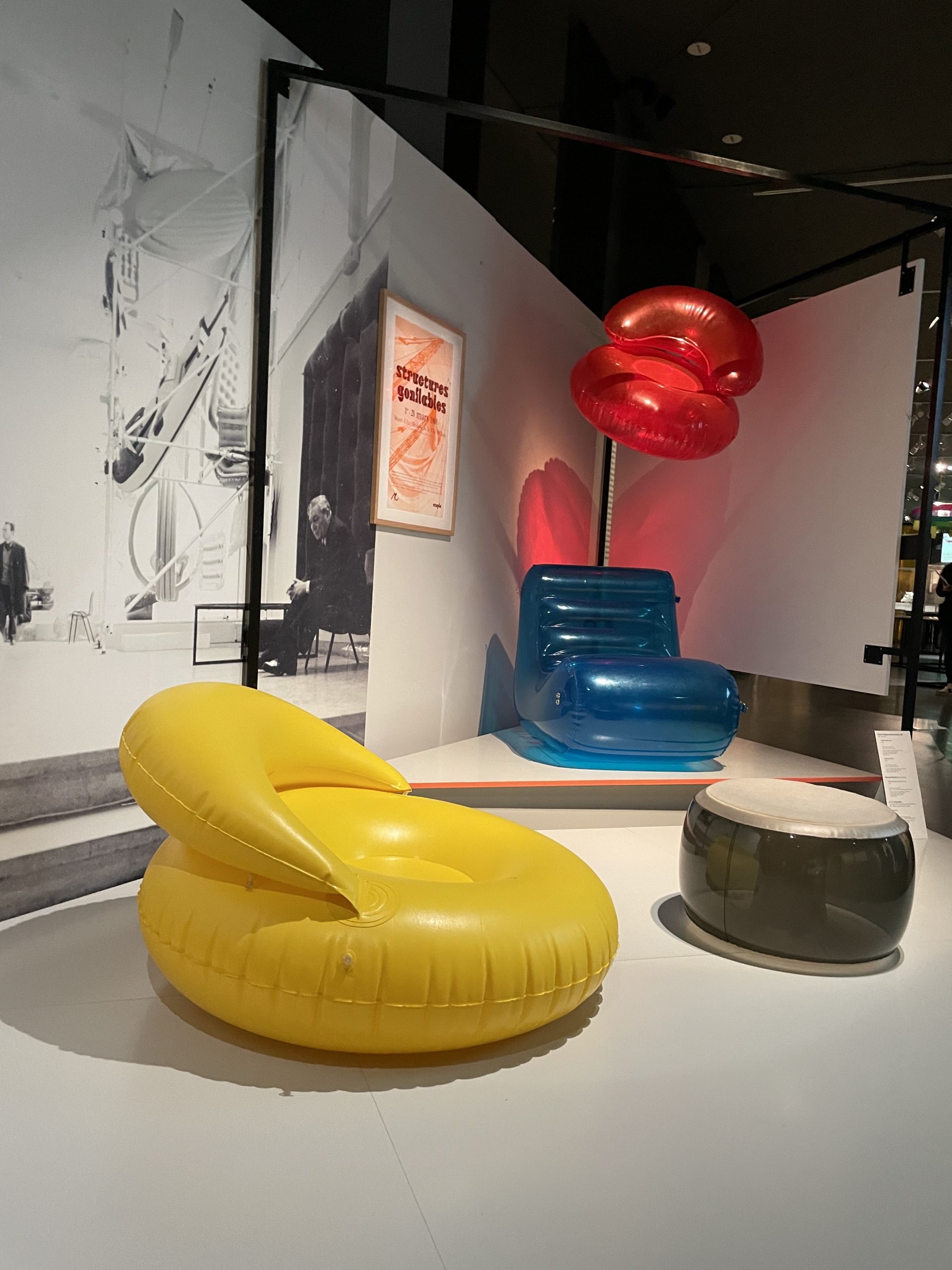
“Aerodream” by the Centre Pompidou-Metz at La cité de l’architecture
Event
Bernard Quentin
06/10/2021 — 14/02/2022
The Aerodream exhibition, designed by the Centre Pompidou-Metz in collaboration with the Cité de l'architecture & du patrimoine, seeks to capture a true cultural phenomenon through the discovery of more than 250 works and a special trail of monumental inflatables scattered throughout the Cité's permanent galleries
The Aerodream exhibition, designed by the Centre Pompidou-Metz in collaboration with the Cité de l’architecture & du patrimoine, seeks to capture a true cultural phenomenon through the discovery of more than 250 works and a special trail of monumental inflatables scattered throughout the Cité’s permanent galleries
Several works by Bernard Quentin are featured in this exhibition.
- – Molécul’air, 1966 – Ed.2020, Pvc
- – ART, H.3M, Collection du Centre Pompidou
- – Croissant, 1963, PVC, Collection du Centre Pompidou
Over a short period of time, many creators from all disciplines embraced inflatables and pneumatic structures as a new medium, a support for multiple forms of action and expression, from the design of objects to that of events, environments, architectural, and urban projects. From the mid-1960s to the early 1970s, artists, architects, engineers, and designers used inflatables to redefine the relationship between architecture and foundations, territories, and space in a new relationship with the body, through multiple interventions and installations. Inflatable forms became symbols of a new way of life, often linked to social or political demands that were widely echoed in advertising and film imagery.
At the junction of various movements, from spatialism to pop art, from Gutai to the Zero Group, from action art to radical architecture, the use of inflatables had a global impact on the European, Japanese, and American scenes, marking a transition between a crisis of modernism that began after the war and the advent of postmodernism. Inflatable structures thus convey two forms of narrative, two imaginaries: one is linked to the developement of technologies, to the industrial and technicl history of pneumatics, from automobiles to aviation, and then to applications in the field of architecture; the other related to the mythology of flight, of the air, to the human dimension and the body, while the tabula rasa of war invites creators to question ideas of origin, and the present and space.
At the heart of the exhibition, these two areas of creation form the basis of an effervescence in which tires are both a medium for creation and, through design and cinema, an expression of new way of being. The heyday of this model is closely linked to the industriel optimism of the 1960s, symbolized by the interiors and furniture of Quasar Khan and Aeroland, a world that disappeared with the oil crisis of the 1970s.
Exhibition until February 14, 2022